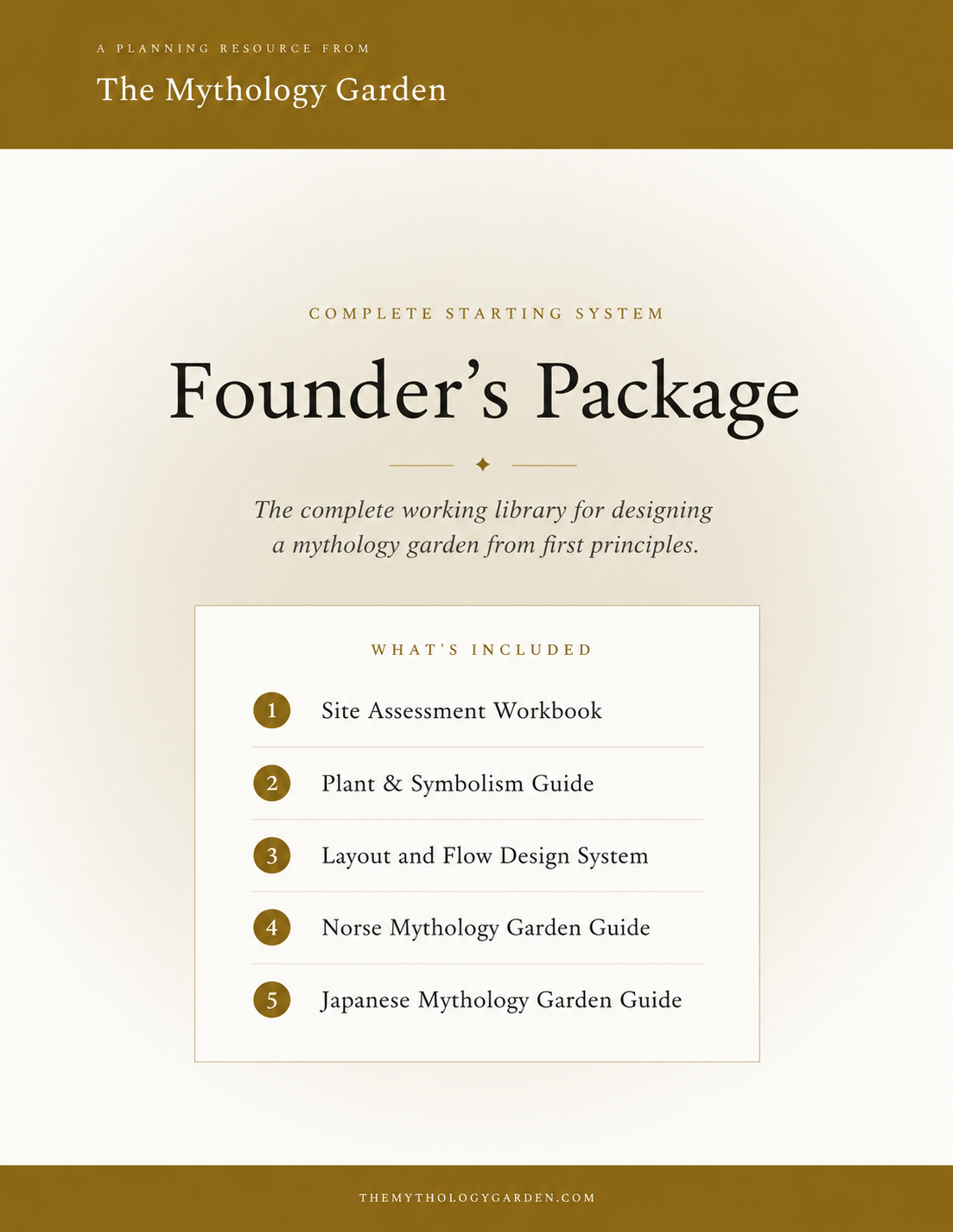
The complete starting system for people ready to move beyond inspiration and begin designing a real mythology garden.
This package includes the Site Assessment Workbook, Plant & Symbolism Guide, Layout and Flow Design System, Norse Mythology Garden Guide, and Japanese Mythology Garden Guide.
Together, these working guides help you read your land, choose a clear design direction, shape paths and focal points, select plants with meaning, and turn mythology into a garden you can actually build.
This is not a collection of decorative ideas. It is a connected design library for making the plants, stone, water, thresholds, seasonal structure, and symbolism all work together.
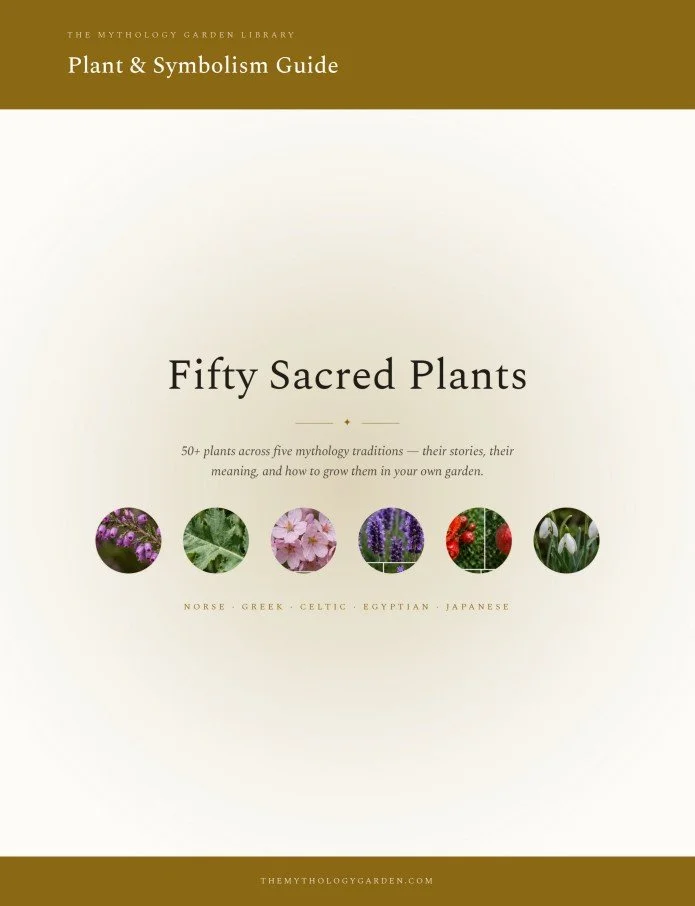
A core resource for starting your mythology garden!
The Plant & Symbolism Guide is a practical reference for choosing plants that carry mythological meaning, seasonal symbolism, and real design purpose.
It profiles fifty sacred plants across Norse, Greek, Celtic, Egyptian, and Japanese traditions. Each entry connects the plant’s story, cultural associations, and garden role with practical guidance for using it in a living outdoor space.
Use it to choose plants that do more than fill a bed - plants that help your garden carry a coherent story through every season.
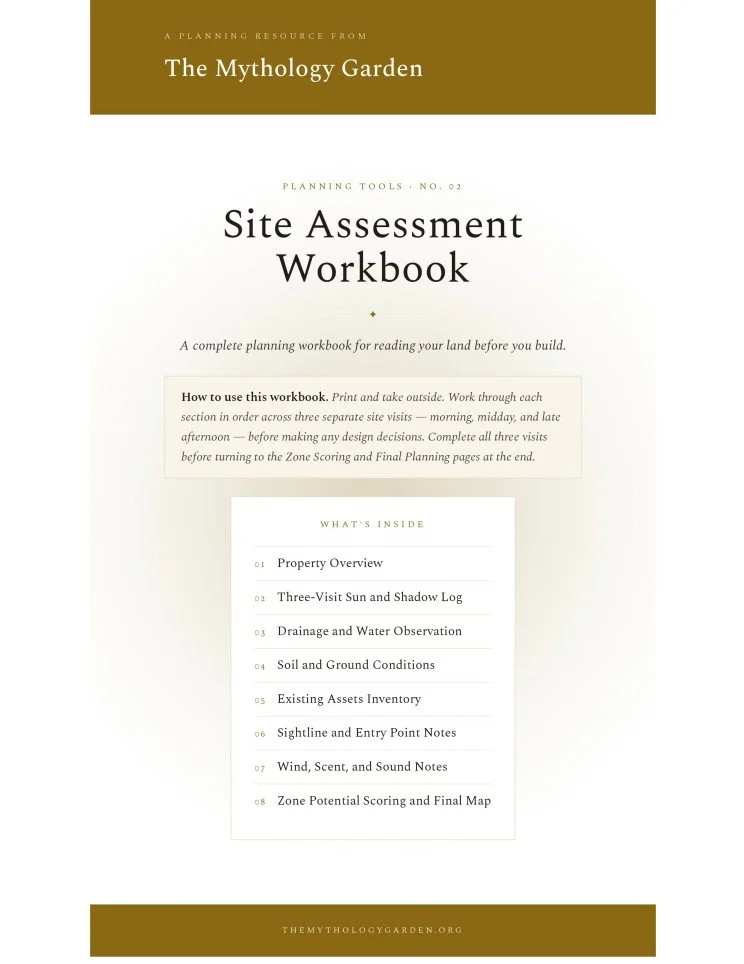
A practical, printable planning workbook for reading your land before you buy plants, move stone, or begin building.
The Site Assessment Workbook is designed to be printed and taken outside. It walks you through the observations that shape a mythology garden before design decisions get expensive: sun and shade, drainage, soil, existing trees and structures, sightlines, wind, sound, and the strongest possible garden zone.
Use it over several visits to your property, then turn those observations into a clearer plan for where your mythology garden should begin.
Format: Printable PDF workbook · 11 pages
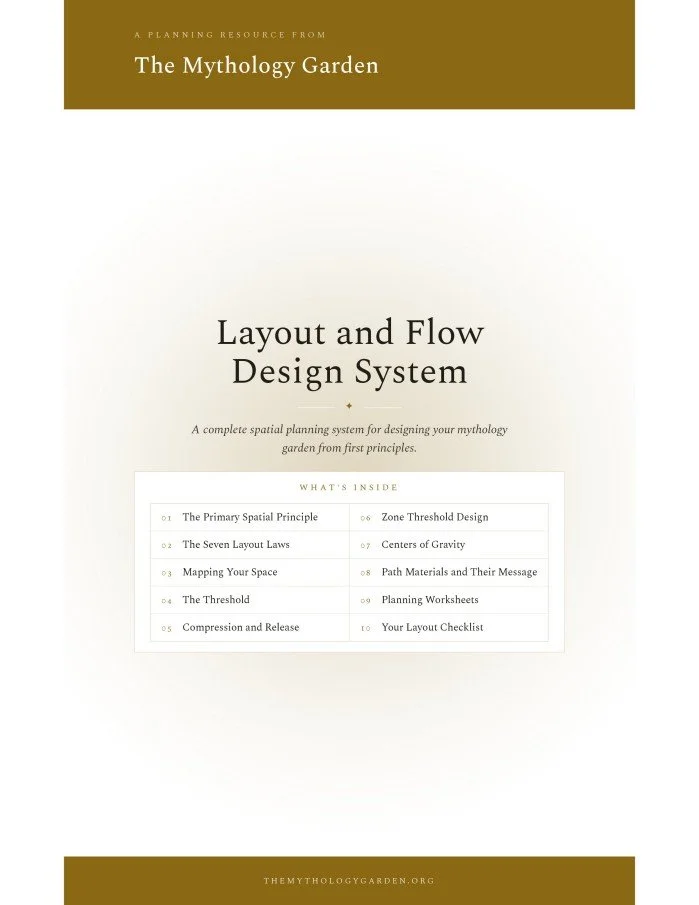
The Layout and Flow Design System helps you design a mythology garden as a sequence of experiences rather than a collection of decorative elements.
This printable planning guide walks you through the spatial decisions that make a garden feel intentional: where someone enters, what they encounter first, what stays hidden, where the path narrows, where the garden opens, and what gives each zone a reason to exist.
Inside, you will find:
The primary spatial principle for mythology garden design
Seven layout laws for creating mystery, movement, and visual depth
A practical base-map process for identifying anchors, problem areas, and opportunity zones
Threshold design guidance for entrances and transitions between garden zones
Compression-and-release planning for making even small spaces feel more dramatic
Zone-transition techniques using materials, planting, sound, water, and scent
Center-of-gravity planning for giving every zone one clear focal purpose
Path-material guidance and width principles
Printable worksheets for planning the visitor journey, zones, infrastructure, and layout decisions
A final layout checklist before you begin building
Designed to print, write on, and use beside your site assessment and garden plans.
A complete design guide for creating a Norse mythology garden in any climate.
This guide translates the Norse cosmos into a real garden language: Yggdrasil as the central anchor, sacred spaces such as the Well of Mimir and Niflheim Zone, Elder Futhark runes, mythologically resonant plants, water features, seasonal structure, and adaptable layout plans.
It is built for people who want more than Viking decoration. The goal is a garden where the plants, stone, thresholds, water, and seasonal character all tell one connected Norse story.
Inside, you will find:
The Norse cosmos as a garden design system
Sacred-space profiles for the Well of Mimir, Niflheim, Bifrost, and a Runestone Garden
Eight Elder Futhark runes with garden-placement guidance
Water-feature concepts rooted in Norse mythology
A twelve-month seasonal garden calendar
Three adaptable layout plans for small, medium, and large spaces
The Japanese Mythology Garden Guide is a complete printable design guide for creating a Japanese mythology garden in any climate.
This is not a generic Japanese garden guide focused only on aesthetics. It explains the mythology beneath the garden: the torii as a threshold, water as purification, stone as presence, moss as accumulated time, seasonal change as ritual, and plants as living mythological elements.
Inside, you will find:
A Shinto cosmology framework for designing the garden as a living sacred landscape
Twelve plant profiles with mythology, symbolism, growing guidance, companions, and climate substitutions
Four sacred garden spaces: the Torii Gate, Tsukubai, Karesansui Cosmos Garden, and Dragon Gate Water Garden
Kami, purification, impermanence, wabi-sabi, mono no aware, and other core concepts explained in garden terms
Water-feature guidance and symbolic design ideas
A twelve-month seasonal calendar built around Japanese festivals and seasonal moments
Scaled layout plans for different garden sizes and climates
No results match your search. Try removing a few filters.